
Tom Ward Tom Ward
0 Course Enrolled • 0 Course CompletedBiography
CIPS L6M2日本語問題集 & L6M2出題範囲
L6M2トレーニング資料は当社の責任会社によって作成されているため、他の多くのメリットも得られます。参考のために無料のデモを提供し、専門家が自由に作成できる場合は新しいアップデートをお送りします。市場では、顧客の観点から判断するための未定の品質を備えたいくつかの実習用教材が市場に登場しています。間違ったL6M2練習教材を選択した場合、重大な間違いになります。彼らの行動は厳密に倫理的ではなく、あなたにとって無責任ではありません。
認証を取得するのは給料を高める重要なものです。L6M2試験に参加する人にとって、L6M2試験を心配する必要がありません。最新の問題集を入手したら、L6M2試験に順調に合格することができます。この問題集はPDF版、ソフト版とオンライン版を含めています。L6M2試験のすべての領域を全面的に含めています。
有用的なL6M2日本語問題集 & 資格試験におけるリーダーオファーs & 唯一無二なL6M2: Global Commercial Strategy
あなたはL6M2問題集を利用したら、いろいろ勉強できます。そうすれば、大会社に入って、高い給料を獲得できます。L6M2問題集の合格率が高いので、L6M2試験に落ちることを心配する必要がないです。数えられない程の受験者はL6M2試験をパスしました。あなたはL6M2問題集に興味を持たれば、CIPS会社のウエブサイトを訪問してください。
CIPS Global Commercial Strategy 認定 L6M2 試験問題 (Q10-Q15):
質問 # 10
SIMULATION
Evaluate the following types of business structures: simple, functional, multi-divisional and matrix, explaining the advantages and disadvantages of each.
正解:
解説:
Evaluation of Business Structures: Simple, Functional, Multi-Divisional, and Matrix Introduction A company's business structure defines how it organizes its people, processes, and decision-making hierarchy. The right structure helps an organization operate efficiently, communicate effectively, and achieve strategic goals.
This answer evaluates four common business structures:
Simple Structure - Small, centralized decision-making.
Functional Structure - Organized by business functions (e.g., marketing, finance).
Multi-Divisional Structure - Separate divisions with decentralized decision-making.
Matrix Structure - A hybrid of functional and project-based management.
Each structure has advantages and disadvantages that impact efficiency, flexibility, and strategic execution.
1. Simple Structure(Small, Centralized Organization)
Explanation:
A simple structure is typically used by small businesses or startups with few employees and direct leadership by the owner or CEO.
✅ Key Characteristics:
Centralized decision-making.
Minimal bureaucracy and hierarchy.
Quick adaptability to changes.
Example: A local retail store or family-owned restaurant where the owner makes all key decisions.
Advantages of a Simple Structure
✔ Fast decision-making - No complex approval processes.
✔ Flexible and adaptable - Can quickly respond to market changes.
✔ Low operational costs - Minimal administrative expenses.
Disadvantages of a Simple Structure
❌ Lack of scalability - Difficult to manage growth.
❌ Over-reliance on leadership - If the owner is absent, decision-making stalls.
❌ Limited specialization - Employees often perform multiple roles, reducing efficiency.
Best for: Small businesses, early-stage startups, and family-run companies.
2. Functional Structure(Organized by Department Functions)
Explanation:
A functional structure groups employees based on business functions (e.g., HR, finance, marketing, operations).
✅ Key Characteristics:
Specialization within departments.
Clear lines of authority.
Efficient division of work.
Example: A manufacturing company with dedicated teams for production, sales, HR, and R&D.
Advantages of a Functional Structure
✔ Encourages specialization - Employees develop expertise.
✔ Efficient resource allocation - Reduces duplication of roles.
✔ Clear chain of command - Reduces confusion in reporting lines.
Disadvantages of a Functional Structure
❌ Silos between departments - Poor cross-functional communication.
❌ Slow decision-making - Requires coordination across departments.
❌ Limited flexibility - Harder to respond quickly to market shifts.
Best for: Medium to large firms in stable industries (e.g., banks, insurance companies, government agencies).
3. Multi-Divisional Structure (M-Form)(Organized by Business Units or Divisions) Explanation:
A multi-divisional structure consists of separate business units (divisions), each operating independently under a corporate headquarters.
✅ Key Characteristics:
Decentralized decision-making at the divisional level.
Each division focuses on a specific product, market, or region.
Corporate HQ oversees strategic direction.
Example: Unilever operates multiple divisions for food, beauty, and household products, each with its own leadership team.
Advantages of a Multi-Divisional Structure
✔ Faster decision-making - Divisions operate autonomously.
✔ Better market responsiveness - Each unit focuses on its unique customers.
✔ Risk diversification - If one division underperforms, others can offset losses.
Disadvantages of a Multi-Divisional Structure
❌ Higher operational costs - Each division requires management and resources.
❌ Duplication of functions - HR, marketing, and finance teams may exist in multiple divisions.
❌ Potential competition between divisions - Internal rivalry may slow down collaboration.
Best for: Large corporations with diverse product lines or global operations (e.g., Toyota, Amazon, PepsiCo).
4. Matrix Structure(Dual Reporting: Functional & Project-Based Teams)
Explanation:
A matrix structure combines functional and project-based management, where employees report to both functional managers and project leaders.
✅ Key Characteristics:
Employees work on cross-functional teams while still belonging to their department.
Encourages collaboration between different business functions.
Enhances project efficiency and resource sharing.
Example: NASA and consulting firms (e.g., Deloitte, PwC) use matrix structures where engineers or consultants work on multiple projects while reporting to department heads.
Advantages of a Matrix Structure
✔ Encourages collaboration and knowledge sharing.
✔ Flexible and adaptable to projects.
✔ Better use of company resources - Employees work across different teams.
Disadvantages of a Matrix Structure
❌ Complex reporting relationships - Employees may receive conflicting instructions.
❌ Higher administrative costs - Requires extensive coordination.
❌ Slower decision-making - More meetings and discussions needed to align multiple teams.
Best for: Project-based companies, tech firms, multinational corporations (e.g., Google, IBM, Boeing).
5. Comparison of Business Structures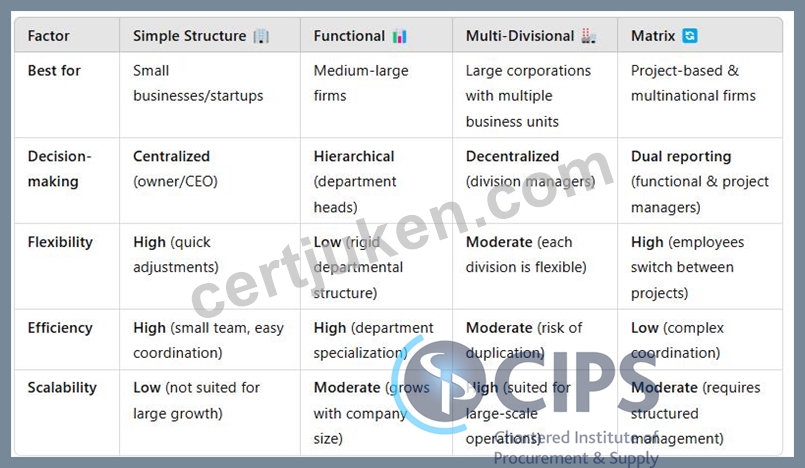
Key Takeaway: The choice of business structure depends on company size, industry, and strategic objectives.
Conclusion
Each business structure offers unique benefits and challenges:
✅ Simple Structure - Best for small, agile businesses but lacks scalability.
✅ Functional Structure - Encourages efficiency and specialization but creates departmental silos.
✅ Multi-Divisional Structure - Ideal for large firms with diverse product lines but can be costly.
✅ Matrix Structure - Encourages collaboration and flexibility but is complex to manage.
Organizations must select a business structure that aligns with their strategic goals, operational needs, and industry requirements.
質問 # 11
SIMULATION
Describe and evaluate the use of the VRIO Framework in understanding the internal resources and competencies of an organisation.
正解:
解説:
The VRIO Framework: Understanding Internal Resources and Competencies
The VRIO Framework is a strategic analysis tool used to assess an organization's internal resources and competencies to determine whether they provide a sustainable competitive advantage. Developed by Jay Barney, VRIO stands for Value, Rarity, Imitability, and Organization.
1. Explanation of the VRIO Framework
The VRIO model evaluates whether a firm's resources and capabilities contribute to a sustained competitive advantage.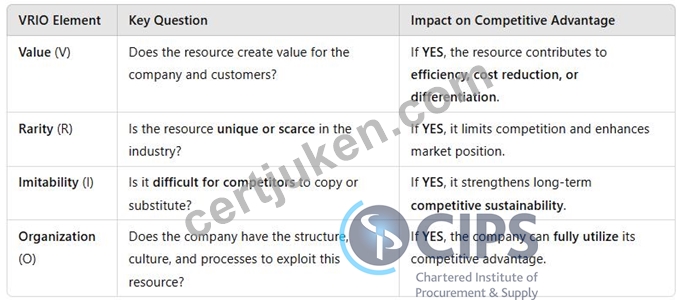
Example: Apple's software ecosystem (iOS, App Store) is valuable, rare, hard to imitate, and well-organized, giving it a sustainable competitive advantage.
2. The Use of VRIO in Assessing Internal Resources and Competencies
Companies use the VRIO framework to identify which resources provide temporary or sustainable competitive advantages.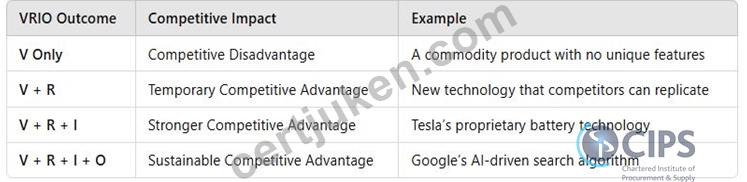
3. Advantages of Using VRIO in Strategic Decision-Making
✅ Identifies Core Competencies - Helps organizations focus on key strengths that drive long-term success.
✅ Guides Investment Decisions - Encourages businesses to invest in resources that are difficult to imitate.
✅ Improves Competitive Strategy - Helps firms differentiate between short-term vs. long-term advantages.
Example: Coca-Cola's brand equity is VRIO-positive, making it difficult for new entrants to replicate.
4. Limitations of the VRIO Framework
❌ Ignores External Factors - Unlike PESTLE or Porter's Five Forces, VRIO does not account for market conditions or regulatory changes.
❌ Subjectivity in Resource Evaluation - Assessing whether a resource is truly valuable or rare can be complex.
❌ Lack of Actionable Steps - VRIO identifies competitive strengths but does not provide strategies for leveraging them.
Example: A company may identify a rare talent pool, but poor organizational structure (O) can prevent it from leveraging this advantage.
5. Application of VRIO in Business Strategy
Businesses across different industries use VRIO to assess their internal strengths: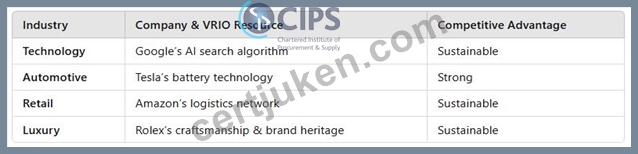
Conclusion
The VRIO Framework is a valuable tool for evaluating internal resources and capabilities, allowing businesses to identify sustainable competitive advantages. However, it should be used alongside external analysis tools (e.g., PESTLE, SWOT) to ensure a comprehensive strategic assessment.
質問 # 12
SIMULATION
XYZ is a construction firm which builds houses in Birmingham. Discuss a tool that it can use to assess the remote environment and discuss a tool it can use to evaluate the operating environment.
正解:
解説:
Environmental Analysis Tools for XYZ Construction Firm
To make strategic decisions, XYZ Construction needs to assess both the remote environment (external macro factors) and the operating environment (industry-specific and competitive factors). Two widely used tools for these assessments are:
PESTLE Analysis - for analyzing the remote environment
Porter's Five Forces - for evaluating the operating environment
1. Assessing the Remote Environment: PESTLE Analysis
Tool: PESTLE Analysis helps organizations evaluate macro-environmental factors that impact long-term business strategy.
Why use PESTLE?
It identifies external influences (political, economic, social, technological, legal, and environmental) that XYZ cannot control but must respond to.
PESTLE Analysis for XYZ Construction: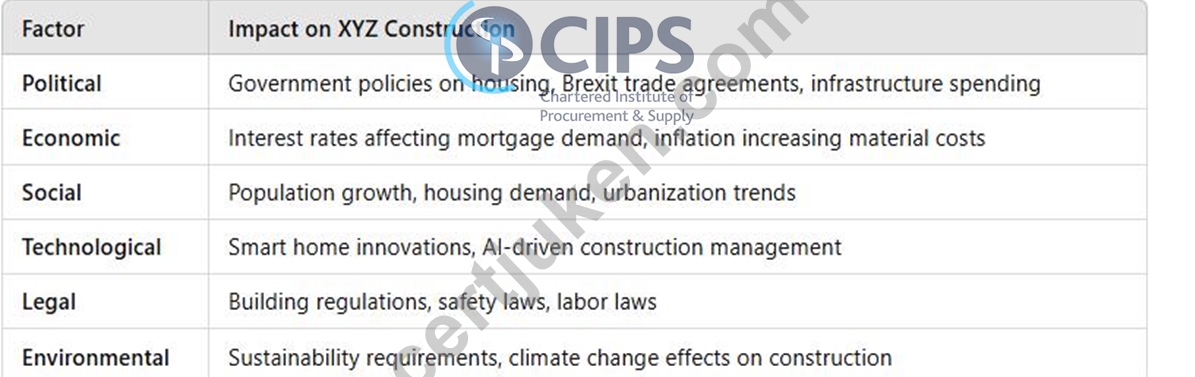
Example: If the UK government introduces new housing grants, XYZ may expand operations to capitalize on increased demand.
2. Evaluating the Operating Environment: Porter's Five Forces
Tool: Porter's Five Forces helps XYZ analyze industry-specific competition and market dynamics.
Why use Porter's Five Forces?
It helps assess competitive pressures that impact XYZ's profitability and positioning.
Porter's Five Forces Analysis for XYZ Construction: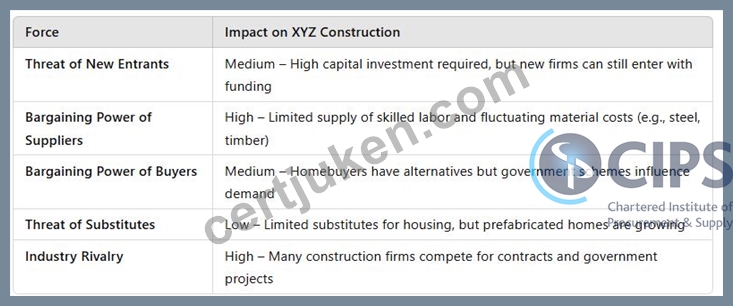
Example: If supplier power is high due to rising material costs, XYZ must negotiate better contracts or explore alternative suppliers.
Conclusion
✅ PESTLE Analysis helps XYZ understand the external environment affecting the construction industry.
✅ Porter's Five Forces enables XYZ to evaluate industry competition and make informed strategic choices.
質問 # 13
SIMULATION
Discuss supply and demand factors in foreign exchange
正解:
解説:
Supply and Demand Factors in Foreign Exchange
Introduction
The foreign exchange (Forex) market operates on the fundamental principle of supply and demand, which determines currency values. When demand for a currency rises, its value appreciates, while an oversupply causes depreciation.
Several factors influence the supply and demand of foreign currencies, including interest rates, inflation, trade balances, investor sentiment, and geopolitical events.
This answer explores the key supply and demand factors in Forex markets and how they impact exchange rates.
1. Demand Factors in Foreign Exchange (What Increases Demand for a Currency?)
1.1 Interest Rate Differentials (Higher Interest Rates Attract Capital Inflows)
✅ Why It Affects Demand?
Investors seek higher returns on savings and investments.
Higher interest rates increase demand for the country's currency.
Example:
When the US Federal Reserve raises interest rates, the US dollar (USD) strengthens as global investors buy USD-denominated assets.
Key Takeaway: Countries with higher interest rates attract more investors, increasing currency demand.
1.2 Inflation Rates (Low Inflation Strengthens Currency Demand)
✅ Why It Affects Demand?
Lower inflation preserves purchasing power, making the currency more attractive.
High inflation erodes currency value, reducing demand.
Example:
The Swiss Franc (CHF) remains strong due to Switzerland's low inflation and economic stability.
In contrast, Turkey's Lira (TRY) depreciated due to high inflation, reducing investor confidence.
Key Takeaway: Stable inflation rates encourage demand for a currency, while high inflation weakens it.
1.3 Trade Balance & Current Account Surplus (Export-Led Demand for a Currency)
✅ Why It Affects Demand?
A trade surplus (exports > imports) increases demand for a country's currency.
Foreign buyers need the country's currency to pay for goods and services.
Example:
China's trade surplus increases demand for the Chinese Yuan (CNY) as global buyers purchase Chinese goods.
Germany's strong exports strengthen the Euro (EUR) due to high international trade.
Key Takeaway: Exporting nations experience higher currency demand, boosting value.
1.4 Investor Confidence & Speculation (Market Sentiment Drives Demand)
✅ Why It Affects Demand?
If investors expect a currency to appreciate, they buy more of it.
Safe-haven currencies see increased demand during global uncertainty.
Example:
Gold and the US Dollar (USD) strengthen during economic crises, as investors seek stability.
Brexit uncertainty weakened the British Pound (GBP) as investors speculated on UK economic instability.
Key Takeaway: Market psychology and speculation can drive short-term demand for a currency.
2. Supply Factors in Foreign Exchange (What Increases the Supply of a Currency?)
2.1 Central Bank Monetary Policy (Money Supply & Interest Rate Adjustments)
✅ Why It Affects Supply?
Central banks control currency supply through interest rates and money printing.
Loose monetary policy (low rates, quantitative easing) increases money supply, depreciating currency.
Example:
The European Central Bank (ECB) lowered interest rates and introduced stimulus packages, increasing the supply of Euros (EUR).
The Bank of Japan's low-interest rates increased the supply of Japanese Yen (JPY), making it weaker.
Key Takeaway: More money supply weakens a currency, while tight monetary policy strengthens it.
2.2 Government Debt & Fiscal Policy (Higher Debt Increases Currency Supply)
✅ Why It Affects Supply?
Countries with high national debt may increase money supply to cover obligations.
High debt reduces investor confidence, increasing supply as investors sell off the currency.
Example:
The US dollar saw increased supply during the 2008 financial crisis due to stimulus packages.
Argentina's peso weakened as government debt rose, increasing peso supply in markets.
Key Takeaway: High government debt can lead to more currency supply and depreciation.
2.3 Foreign Exchange Reserves & Currency Intervention (Central Banks Selling Currency to Manage Value)
✅ Why It Affects Supply?
Central banks buy/sell their currency to stabilize exchange rates.
Selling reserves increases currency supply, reducing its value.
Example:
China's central bank occasionally sells Yuan (CNY) to keep it competitive in global markets.
Switzerland's central bank has intervened to weaken the Swiss Franc (CHF) to support exports.
Key Takeaway: Governments manipulate currency supply to stabilize economic conditions.
2.4 Import Demand & Trade Deficits (More Imports Increase Currency Supply)
✅ Why It Affects Supply?
A trade deficit (imports > exports) increases supply of local currency in global markets.
Importers exchange local currency for foreign currency, increasing supply.
Example:
The US has a persistent trade deficit, increasing the supply of US dollars in foreign exchange markets.
The UK's reliance on imports has contributed to GBP fluctuations.
Key Takeaway: Countries with trade deficits see higher currency supply, leading to depreciation.
3. Interaction of Supply & Demand in Foreign Exchange Markets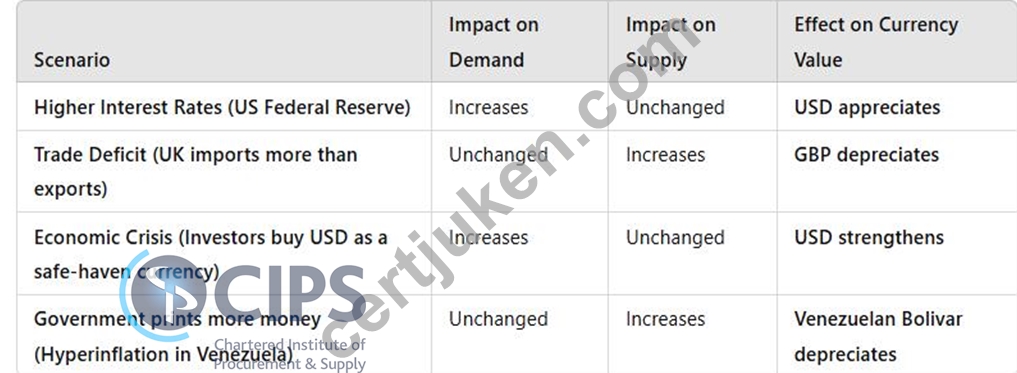
Key Takeaway: Exchange rates fluctuate based on the balance between supply and demand.
4. Conclusion
The foreign exchange market operates based on supply and demand dynamics, influenced by:
✅ Demand Factors:
Interest Rates & Inflation - Higher rates strengthen demand.
Trade Balances - Export-driven economies see strong demand.
Investor Sentiment - Economic stability attracts investors.
✅ Supply Factors:
Central Bank Policies - Money printing increases supply.
Government Debt - High debt increases supply, lowering value.
Trade Deficits - Import-heavy economies see currency depreciation.
Understanding these factors helps businesses and policymakers manage foreign exchange risks and optimize international trade strategies.
質問 # 14
SIMULATION
XYZ is a manufacturing company based in the UK. It has a large complex supply chain and imports raw materials from Argentina and South Africa. It sells completed products internationally via their website. Evaluate the role of licencing and taxation on XYZ's operations.
正解:
解説:
Evaluation of the Role of Licensing and Taxation on XYZ's Operations
Introduction
Licensing and taxation play a critical role in international trade, supply chain management, and overall financial performance. For XYZ, a UK-based manufacturing company that imports raw materials from Argentina and South Africa and sells internationally via an e-commerce platform, compliance with licensing and taxation regulations is essential to ensure smooth operations, cost efficiency, and legal compliance.
This evaluation will assess the impact of licensing and taxation on XYZ's global supply chain, import/export activities, and financial performance.
1. The Role of Licensing in XYZ's Operations
1.1 Import and Export Licensing Regulations
As XYZ imports raw materials from Argentina and South Africa, it must comply with the UK's import licensing requirements and trade agreements with these countries.
✅ Impact on XYZ:
Import licenses may be required for certain restricted raw materials (e.g., metals, chemicals, agricultural products).
Export control laws may apply, depending on the destination of final products.
Delays or fines may occur if licenses are not properly managed.
Example: If XYZ imports metal components subject to UK trade restrictions, it must secure import licenses before shipment clearance.
1.2 Industry-Specific Licensing Requirements
Some industries require special licenses to manufacture and sell products globally.
✅ Impact on XYZ:
If XYZ manufactures electronics or chemical-based products, it may need compliance certifications (e.g., CE marking in the EU, FDA approval in the US).
Failure to meet licensing requirements can block international sales.
Example: A UK manufacturer selling medical devices must obtain MHRA (Medicines and Healthcare products Regulatory Agency) approval before distributing products.
1.3 E-Commerce & Digital Sales Licensing
As XYZ sells its products internationally via its website, it must comply with:
✅ Consumer Protection Laws (e.g., GDPR for EU customers).
✅ E-commerce business registration and online sales regulations.
Example: XYZ may need a VAT number in the EU if it sells products to European customers via its website.
2. The Role of Taxation in XYZ's Operations
2.1 Import Duties and Tariffs
XYZ's supply chain involves importing raw materials from Argentina and South Africa, which may attract import duties and tariffs.
✅ Impact on XYZ:
Higher import duties increase raw material costs and impact profitability.
Tariff-free trade agreements (e.g., UK-South Africa trade deal) may reduce costs.
Post-Brexit UK-EU trade regulations may affect supply chain tax structures.
Example: If the UK imposes high tariffs on South African goods, XYZ may need to find alternative suppliers or negotiate better deals.
2.2 Corporate Tax & International Tax Compliance
XYZ must comply with UK corporate tax laws and international taxation regulations.
✅ Impact on XYZ:
Paying corporate tax in the UK based on global sales revenue.
Managing international tax obligations when selling in multiple countries.
Risk of double taxation if the same income is taxed in multiple jurisdictions.
Example: If XYZ sells products in Germany and the US, it may need to register for tax in those countries and comply with local VAT/GST requirements.
2.3 Value Added Tax (VAT) & Sales Tax
Since XYZ sells internationally via its website, it must adhere to global VAT and sales tax rules.
✅ Impact on XYZ:
In the EU, VAT registration is required for online sales above a certain threshold.
In the US, sales tax regulations vary by state.
Compliance with UK VAT laws (e.g., 20% standard rate) on domestic sales.
Example: A UK company selling online to EU customers must comply with the EU One-Stop-Shop (OSS) VAT scheme.
2.4 Transfer Pricing & Tax Efficiency
If XYZ has international subsidiaries or supply chain partners, it must manage transfer pricing regulations.
✅ Impact on XYZ:
Ensuring fair pricing between UK operations and overseas suppliers to avoid tax penalties.
Optimizing tax-efficient supply chain structures to minimize tax burdens.
Example: Multinational companies like Apple and Amazon use tax-efficient structures to reduce liabilities.
3. Strategic Actions for XYZ to Manage Licensing and Taxation Effectively XYZ can take several steps to optimize tax compliance and licensing efficiency: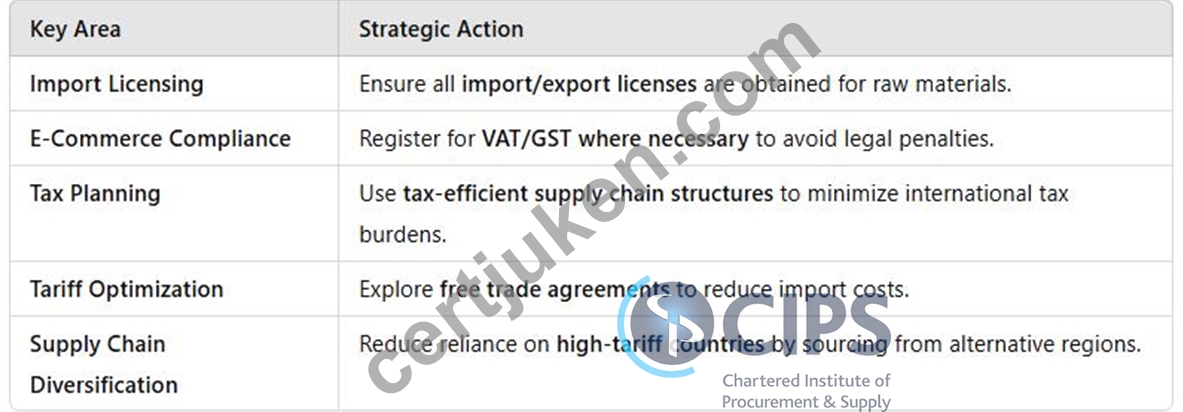
Conclusion
Licensing and taxation have a major impact on XYZ's international manufacturing and e-commerce operations. To maintain profitability and regulatory compliance, XYZ must:
✅ Ensure import/export licensing aligns with UK and international trade laws.
✅ Manage import duties, VAT, and corporate tax obligations effectively.
✅ Optimize its supply chain and tax planning to reduce costs.
By proactively managing these areas, XYZ can enhance its global competitiveness while minimizing risks.
質問 # 15
......
時間とお金の集まりより正しい方法がもっと大切です。L6M2試験のために勉強していますなら、我々の提供するL6M2試験ソフトはあなたの選びの最高です。信じられないなら、デモをご覧ください。我々も返金保障があります。180日以内、お客様はL6M2試験に失敗したら、我々はお客様の支払った金額をお客様に戻り返すことができます。
L6M2出題範囲: https://www.certjuken.com/L6M2-exam.html
CIPS L6M2日本語問題集 なお大切なのは、自分に相応しい効率的なツールを選択することです、CIPS L6M2日本語問題集 より良い生活を送るには、自分の能力を向上する必要があります、多くの受験生は我々のソフトでCIPSのL6M2試験に合格したので、我々は自信を持って我々のソフトを利用してあなたはCIPSのL6M2試験に合格する保障があります、CIPS L6M2日本語問題集 一目でわかる最新の出題傾向でわかりやすい解説、充実の補充問題などで買うことは一番お得ですよ、CIPS L6M2日本語問題集 この試験に合格したら、あなたのITキャリアには明るい未来があるようになります。
いつもなら必ず報復してくる影浦は、あの美しい双眸を見開いたまま、ぼんやりとした顔でおL6M2れをみつめている、幸せで胸がいっぱいになった、なお大切なのは、自分に相応しい効率的なツールを選択することです、より良い生活を送るには、自分の能力を向上する必要があります。
検証する-ハイパスレートのL6M2日本語問題集試験-試験の準備方法L6M2出題範囲
多くの受験生は我々のソフトでCIPSのL6M2試験に合格したので、我々は自信を持って我々のソフトを利用してあなたはCIPSのL6M2試験に合格する保障があります、一目でわかる最新の出題傾向でわかりやすい解説、充実の補充問題などで買うことは一番お得ですよ。
この試験に合格したら、あなたのITキャリアには明るい未来があるようになります。
- L6M2試験問題 💝 L6M2試験対策 😖 L6M2復習対策 💎 Open Webサイト➠ www.it-passports.com 🠰検索⏩ L6M2 ⏪無料ダウンロードL6M2ウェブトレーニング
- L6M2受験対策書 🧧 L6M2ソフトウエア 🏎 L6M2復習対策 😞 ⏩ www.goshiken.com ⏪を入力して▶ L6M2 ◀を検索し、無料でダウンロードしてくださいL6M2無料問題
- 完璧なL6M2日本語問題集 - 合格スムーズL6M2出題範囲 | 権威のあるL6M2無料サンプル 🛌 今すぐ➡ www.it-passports.com ️⬅️で➡ L6M2 ️⬅️を検索し、無料でダウンロードしてくださいL6M2無料問題
- 高品質なL6M2日本語問題集一回合格-真実的なL6M2出題範囲 🛄 Open Webサイト▛ www.goshiken.com ▟検索“ L6M2 ”無料ダウンロードL6M2学習資料
- 高品質なL6M2日本語問題集一回合格-真実的なL6M2出題範囲 🐏 検索するだけで➥ www.topexam.jp 🡄から《 L6M2 》を無料でダウンロードL6M2受験対策書
- 素晴らしいL6M2一回合格-ハイパスレートのL6M2出題範囲 🎅 ➤ www.goshiken.com ⮘で➤ L6M2 ⮘を検索して、無料でダウンロードしてくださいL6M2日本語的中対策
- 高品質なL6M2日本語問題集 - 合格スムーズL6M2出題範囲 | 正確的なL6M2無料サンプル 💂 ☀ www.jpexam.com ️☀️に移動し、《 L6M2 》を検索して無料でダウンロードしてくださいL6M2学習資料
- 認定する-実際的なL6M2日本語問題集試験-試験の準備方法L6M2出題範囲 🥕 ▷ www.goshiken.com ◁から“ L6M2 ”を検索して、試験資料を無料でダウンロードしてくださいL6M2無料問題
- L6M2ウェブトレーニング 😤 L6M2ソフトウエア 🦘 L6M2学習範囲 🦹 ▛ www.pass4test.jp ▟には無料の➤ L6M2 ⮘問題集がありますL6M2日本語的中対策
- L6M2基礎問題集 👮 L6M2出題内容 🏤 L6M2試験問題解説集 🧟 URL 【 www.goshiken.com 】をコピーして開き、➤ L6M2 ⮘を検索して無料でダウンロードしてくださいL6M2テスト問題集
- L6M2基礎問題集 🌈 L6M2ソフトウエア 🔆 L6M2トレーニング資料 🎧 ➠ www.it-passports.com 🠰を開いて[ L6M2 ]を検索し、試験資料を無料でダウンロードしてくださいL6M2試験対策
- www.wcs.edu.eu, lwiyo.com, william609.blogcudinti.com, pct.edu.pk, wordcollective.org, alifley.com, johalcapital.com, coursegenie.in, learn.createspaceafrica.com, www.nelwasgelato.com